Monday, September 30, 2013

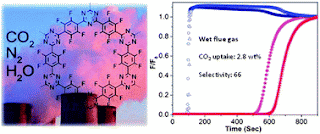
A perfluorinated covalent triazine-based framework for highly selective and water–tolerant CO2 capture

Y. Zhao, K. X. Yao, B. Teng, T. Zhang, Y. Han*
Energy Environ. Sci., 2013, 6, 3684-3692. DOI: 10.1039/C3EE42548G
Notes & Highlights:
  • FCTF-1 has one of the highest physisorptive (Q0st, FCTF-1 = 35 kj/mol) CO2 capacities ever recorded: 5.53 mmol/g at 273 K and 1 bar (1.76 at 0.1)
  • CO2/N2 selectivity increased when mixed gas measured compared to pure gas calculations. This verifies a 2011 observation by Guiver et al.
  • Moisture (0.03 bar, % 100 RH) lowered CO2 uptake 12 % at 298 K.

Sunday, April 3, 2011

Polymer nanosieve membranes for CO2-capture applications

N. Du, H. B. Park, G. P. Robertson, M. M. Dal-Cin, T. Visser, L. Scoles, M. D. Guiver*
Nature Mater., 2011, 10,  372-375 DOI: 10.1038/NMAT2989

Notes & Highlights:

  • TZPIM-1 is one of the few membranes that broke the Robeson plot for CO2/N2 selectivity.
  • Guiver also proved calculations from single gas isotherms show lesser selectivity than actual mixed gas measurements.


Thursday, October 14, 2010

Functional Materials: From Hard to Soft Porous Frameworks

Arne Thomas*
Angew. Chem. Int. Ed., 2010, 49, 8328 – 8344 DOI: 10.1002/anie.201000167

Notes & Highlights:

  • One of the rare reviews that captures the contrast between hard (mostly inorganic) and soft (organic) framework structures.
  • All materials have function, there is no such thing as "functional" material.